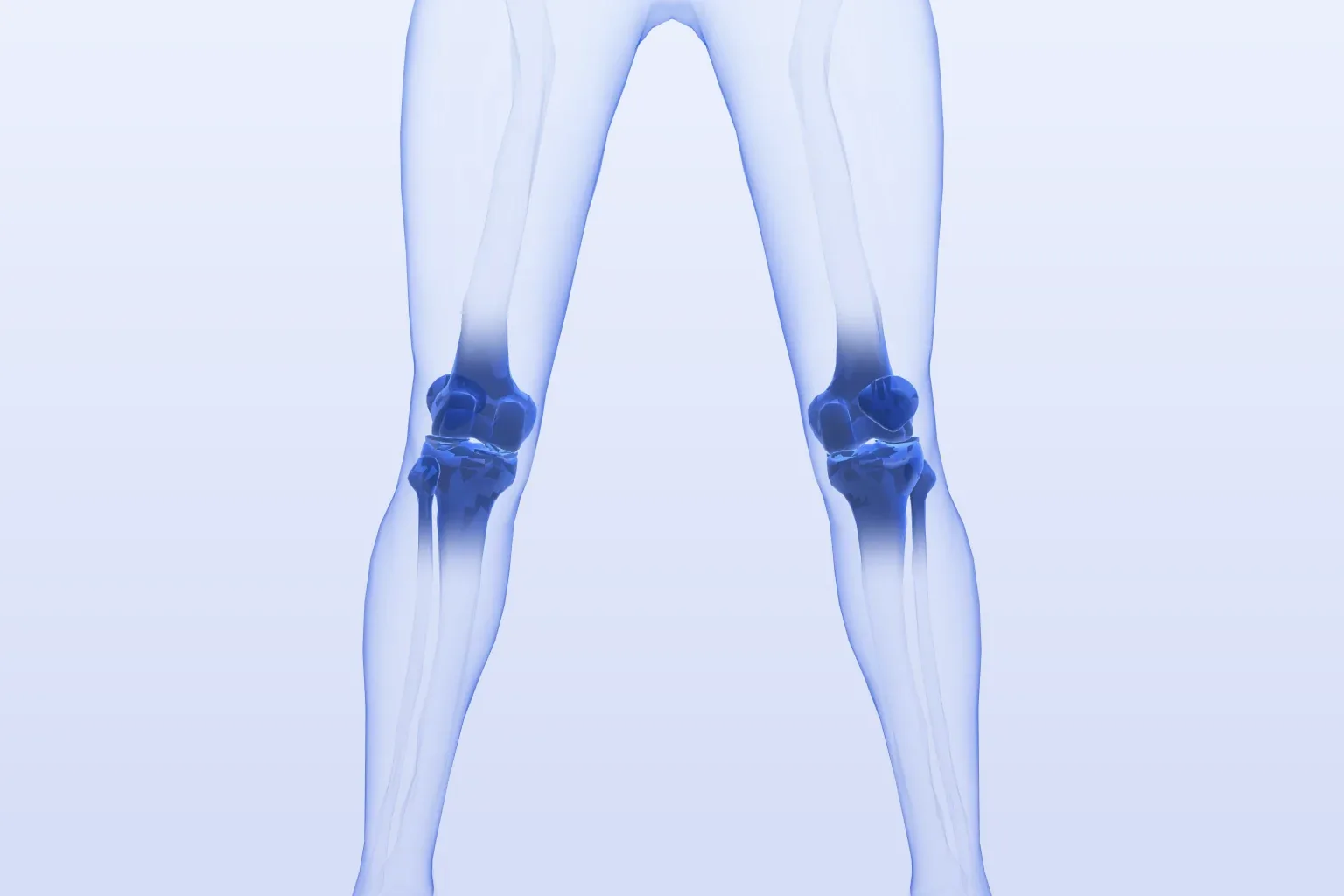
Lower risk of knee arthritis
- Published in
- Ann Intern Med 1992
- People studied
- 796
In 796 women, those whose BMI fell by 2 points or more over 10 years had less than half the odds of painful knee osteoarthritis.
- Checked against
- PubMed 1543306
- Published in
- Ann Intern Med 1992
- Last checked
- 30 October 2026
Key takeaway
Among 796 women in the Framingham Study, 64 had recently developed painful knee osteoarthritis. Women whose BMI fell by 2 points or more (about 5 kg) over the previous 10 years had less than half the odds of developing it. The link also held in women who started with a BMI of 25 or more.
At a glance
- Type of study
- long-term population study (Framingham)
- People studied
- 796
- How long
- 10 years
- Compared with
- women whose BMI did not fall by 2 points
- Main result
- A BMI 2 points lower went with less than half the odds of painful knee osteoarthritis.
- Strength of evidence
- Long-term or observational studies
What this study does not show
An observational study in women only, and the start of symptoms was recalled from memory. It shows an association, not proof of cause.
Results from studies in groups of people, mostly in diet and movement programmes. They cannot be promised to any one person. This information is educational and does not replace a consultation with a doctor.
More on joints
- Less load on the kneeLong-term or observational studies · Messier et al., Arthritis Rheum 2005
- Lower risk of knee arthritisLong-term or observational studies · Felson et al., Ann Intern Med 1992
- Easier movementRandomised trials · Christensen et al., Ann Rheum Dis 2007
- Less knee painRandomised trials · Messier et al., JAMA 2013
- Slightly less knee painRandomised trials · Messier et al., JAMA 2022
- Better mobilityRandomised trials · Rejeski et al., NEJM 2012
- More weight lost, more reliefSmall or uncontrolled studies · Atukorala et al., Arthritis Care Res 2016
The next step is a conversation, not a decision
A licensed doctor decides whether any treatment is right for you. The answer can also be no treatment.
 1
You fill in a short form
 2
We call you within 24 hours
 3
A paid 20-minute video consultation with a doctor
 4
The doctor goes through your options and decides what is right for you